Second International Conference on Civil, Architecture, Development and Reconstruction of Urban Infrastructure

About Hamburg
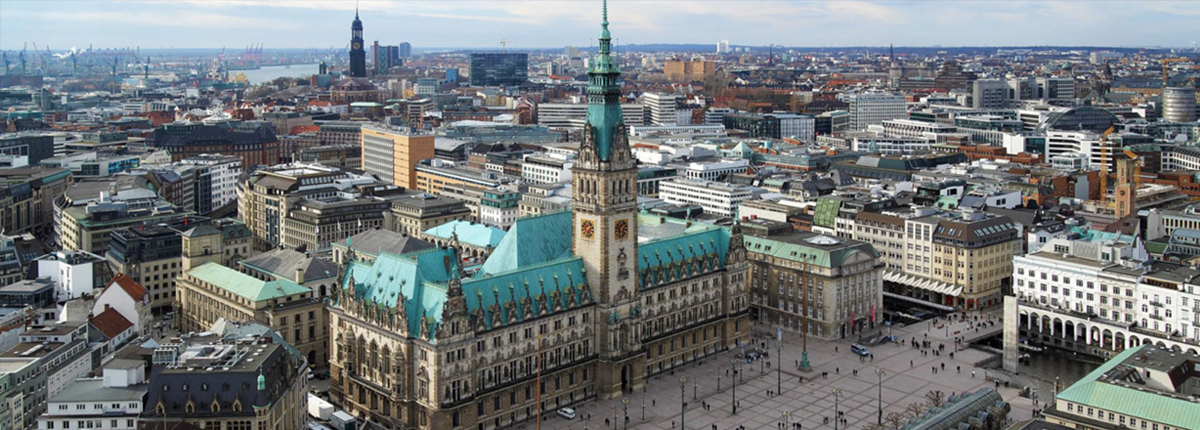
Hamburg is the second largest city in Germany after Berlin and the eighth largest in the European Union, and the third largest port in Europe after Rotterdam and Antwerp. Hamburg is a city-state, meaning it is also one of the sixteen German states. It is located on the Elbe River. Hamburg is twice the size of London and seven times the size of Paris.
The official name reflects Hamburg's history as a member of the medieval Hanseatic League and a free imperial city of the Holy Roman Empire. Before German unification in 1871, it was a fully independent city-state, and before 1919 it was a civil republic, governed by a constitutional class of hereditary grand burghers or Hanseaten. Despite disasters such as the Great Fire of Hamburg, the North Sea Flood of 1962, and military conflicts including the bombing of World War II, the city has managed to recover and become wealthier after each disaster.
Hamburg is the third largest port in Europe after Rotterdam and Antwerp. The major regional broadcaster NDR, the publishing house Gruner + Jahr, and the newspapers Spiegel and Die Zeit are all based in the city. Hamburg is home to Germany's oldest stock exchange and the world's oldest merchant bank, Bank Bernberg. Media, trade, logistics and industrial companies with significant locations in the city include the multinationals Airbus, Blohm + Voss, Aurubis, Beiersdorf and Unilever. Hamburg is also a major hub for science, research and education in Europe, with several universities and institutes. The city has a very high quality of life, ranking 19th in the Mercer Quality of Living Survey 2019.
History
The Bishopric of Hamburg was founded by Louis the Pious, King of the Franks, as a headquarters for missionaries active in Scandinavia. The city was sacked by the Vikings in 845.
Geography
Hamburg is located in the south of the Jutland peninsula; To the south is continental Europe, to the north is Scandinavia, to the west is the North Sea, and to the east is the Baltic Sea. The city is located on the Elbe River, which is formed by the junction of the Alster and the Beale. Hamburg has an oceanic climate influenced by the Atlantic Ocean.
Demographics
Of the total of one million eighty-four thousand citizens residing in Hamburg, 631 thousand, or thirty-four percent, have an immigrant background, and 302 thousand, or sixteen percent, have non-German citizenship, which makes Hamburg a suitable destination for immigration.
Urban divisions
Hamburg has seven districts and municipalities, including Hamburg Mitte, Altona, Eimsbüttel, Hamburg Nord, Wensbeck, Bergdorf and Harburg. These seven districts of Hamburg are divided into 104 urban districts.
Transport
Hamburg Airport and Hamburg Finkenwerder Airport are two international and private airports that handle air transport, and Hamburg Central Station is one of the most important railway stations in Germany. The Hamburg S-Bahn was also launched as a suburban railway with 8 lines and 150 stations in 1972.
The Hamburg U-Bahn was founded in 1912 and currently has 4 lines and 91 stations. It is one of the oldest metros in the world. There are 1,700 kilometers of bicycle paths in Hamburg, and according to government plans, another 280 kilometers will be added to this amount by 2020.
Stock Exchange
The Hamburg Stock Exchange began operating in 1558 as the first German stock exchange and the fourth European stock exchange. At the beginning of the 21st century, the exchange was specialized only for credit and investment trading.
Media
With 70,000 people employed in the media industry and a turnover of 25 billion euros, Hamburg is one of the most important media cities in Germany. A total of 14,063 large and small companies in the advertising, music, film, publishing, printing and television sectors are registered in the city. The most important journalism universities and media training institutes are also located in Hamburg. The headquarters of the print magazines and newspapers Spiegel, Stern and Die Zeit are located in Hamburg, as is the headquarters of Germany's largest media company Axel Springer (Bild). More than 50 percent of all printing services in Germany are carried out in the city.
Occupations
According to official statistics from 2014, a total of 1,193,400 people are employed in economic activities in Hamburg, of which 339,600 are self-employed, 393,100 in trade, transport and tourism, information and communications, 304,300 in service companies (finance and real estate), 115,900 in manufacturing, 38,200 in housing and construction, and 2,400 in agriculture and fishing.
Politics
In the Hamburg parliamentary elections in February 2020, the Social Democratic Party won 54 seats. The Christian Democratic Union won 15 seats, the Alliance 90/Greens 33 seats, the Left Party (Germany) 13 seats, the right-wing Alternative for Germany 7 seats, and the Free Democratic Party 1 seat out of a total of 123 seats in the Hamburg parliament. Before the 2020 elections, the Hamburg government was a coalition of the Greens and the Social Democrats.
Education
In addition to public schools and vocational schools, Hamburg has special schools for people with mental and physical disabilities. There are also nineteen higher education institutions in Hamburg. According to statistics from 2012, 222,700 students were studying in schools and 297 institutions with a school structure in 2018. Of this total, 19,300 people studied in 95 private schools. According to these statistics, 75,515 students were studying in the city this year. Hamburg is one of the German cities where the education system is growing, and in this regard, the Hamburg parliament has allocated an additional budget of two billion euros for the years 2013 to 2019.
Tourism
In the past ten years, Hamburg has had the highest tourist development index in Europe. In 2015, Hamburg was one of the eleven most popular tourist destinations in Europe, with around 12.6 million people staying in Hamburg at least one night. Hamburg is one of the cities in Germany that has five-star hotels.
Weather
The Hamburg Warehouse District is an area in the city of Hamburg, located on the banks of the Elbe River. This area is home to a series of interconnected warehouses, which are the largest warehouses of their kind in the world. The Hamburg Warehouse District is a UNESCO World Heritage Site and is considered one of the symbols of the city of Hamburg.
The climate of Hamburg is warm and maritime. Due to the dominant influence of the maritime climate in the west, the weather is mildly cold in winter and cooler in summer than in the eastern regions of the country.
Port of Hamburg
The Port of Hamburg, known as Germany's gateway to the world, is the largest port in Germany, the third largest port in Europe, and the fifteenth largest port in the world. The area of this port is 7,399 hectares, and most of the work of this port is carried out through container transport.